
Cat Gum Color Chart: What Healthy and Unhealthy Gums May Mean

About the Author
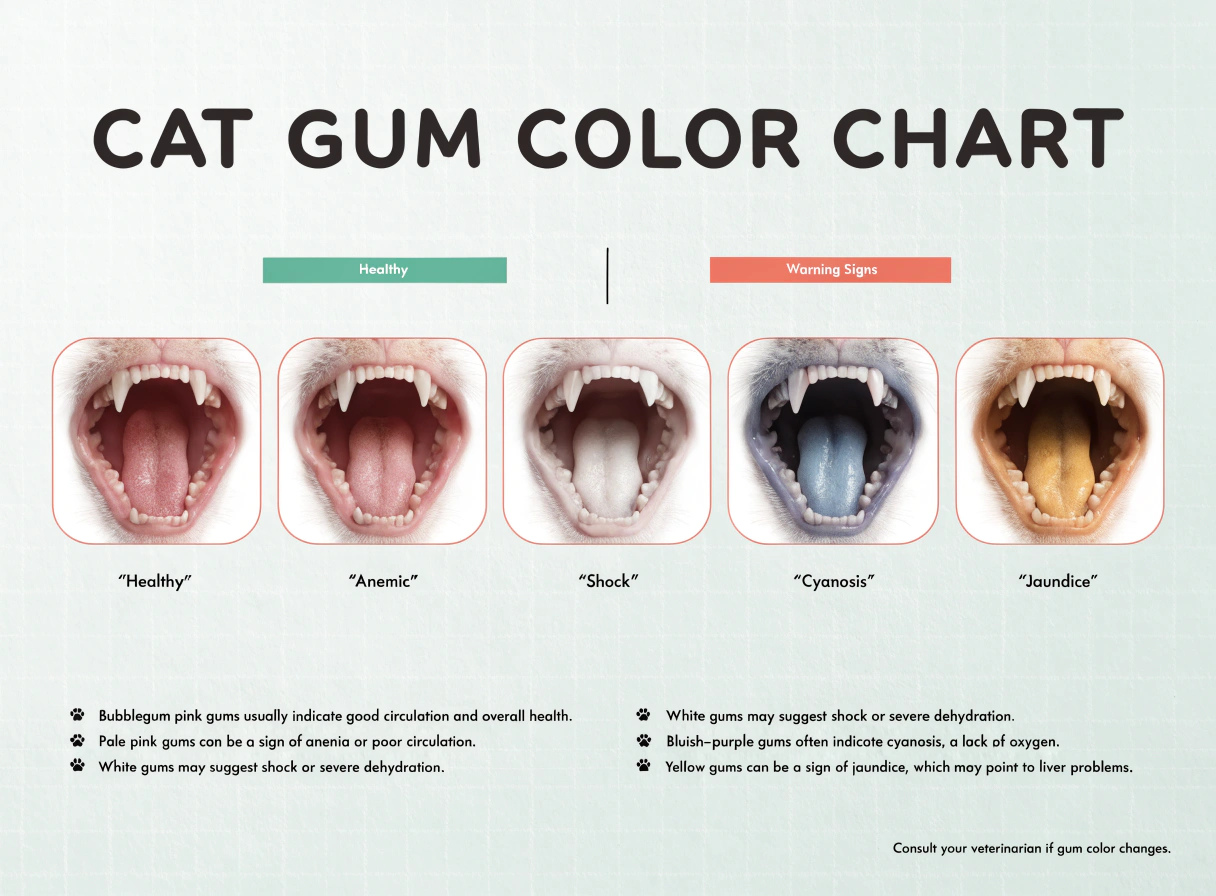
A five-second look at your cat's gums tells you more than you'd think. Color, texture, moisture, they shift before most other signs of trouble show up, which is exactly why a quick gum check is one of the easiest health habits you can build. The Cat Gum Color Chart below turns that quick look into something you can actually read: what each shade tends to mean and when it's worth acting on. The catch is knowing your cat's normal, so a change actually registers. You can check the same three things each time. Color. Texture and moisture. Press and see how fast the color comes back after you press. Do it while your cat is calm, and you'll spot a problem early instead of after they've stopped eating. ● Healthy Bubblegum pink, moist and smooth, with color returning in 1–2 seconds after you press. ● Get it checked Bright red, brown or new dark spots, or a raised lump book a vet visit for dental disease or a growth. ● Emergency Pale/white, blue/purple, or yellow gums or a refill over 2 seconds with lethargy means emergency. What Healthy Cat Gums Look Like Healthy gums give you a baseline to measure against. You need to learn the normal color, feel, and refill speed, and anything off becomes obvious fast. Color: Learn Your Cat's Normal Many healthy cats have light-to-medium pink gums, but the normal shade varies. Some cats also have flat, long-standing dark pigment. Learn your cat's usual color in natural light so a new change is easier to recognize. Texture (Smooth, Moist, Slightly Slippery) Healthy gum tissue is generally smooth and moist. Dry, tacky, swollen, ulcerated, bleeding or painful tissue deserves attention, especially when it appears with appetite or behavior changes. Capillary Refill Time (CRT) Capillary refill time (CRT) describes how quickly color returns after gentle pressure on an unpigmented area. Veterinary triage references commonly use one to two seconds as a normal finding, but a home check cannot diagnose circulation or hydration problems. How to Safely Check Your Cat's Gums First, keep your cat calm and controlled. A relaxed cat gives you an accurate read and doesn't learn to dread the next check. Choose a Calm, Relaxed Moment You can pick a quiet window like after a meal while mid-cuddle. You can skip it when your cat is wound up or overstimulated; a stressed cat gives you a stressed reading. Lift Upper Lip and Observe Gum Line Gently lift one side of the upper lip to expose the gum above the teeth. Note color, texture, any pigment or sores. You need to repeat it on the other side so you're comparing like with like. Check CRT Only When It Is Safe Use one accessible, unpigmented area only if your cat is calm and comfortable. Do not force the mouth open, repeat the test on a distressed cat, or use CRT alone to decide that a cat is safe. Stop if Your Cat Resists You need to watch how your cat reacts. A sudden flinch, pulling away, or growling can mean pain or anxiety, and they matter as much as anything you see. A cat that reliably lounges in its own calm, familiar spots tends to tolerate handling better, which is one more reason a settled home environment makes these checks easier. Natural Pigmentation vs Concerning Color Dark spots in a cat's mouth often cause worry, but many are harmless, and texture and shape are what separate a birthmark from a real problem. Warning Signs: New, Raised, or Changing Spots Lentigo Simplex (Benign Spots) • Flat patches are usually fine. However, a spot that rises above the surrounding tissue needs a professional. • Malignant melanoma can mimic benign pigment but tends to show up raised, bumpy, or thickened. You should track anything that grows fast, changes color, or bleeds. • Book an exam to rule out an oral tumor if dark spots suddenly appear on an older cat that never had them. • Orange cats, calicos, and tortoiseshells have a genetic susceptibility for developing small flat brown-black spots known as lentigo simplex. • These appear on the gums, lips, nose, and around the eyes, typically appearing at a relatively young age as dots which gradually grow in number. Cat Gum Color Chart: What Each Color Indicates A cat's gums are a direct window into their circulation and overall health. Checking them regularly builds the baseline that lets you catch a life-threatening change fast. Use this as a reference for what you're seeing — not as a diagnosis on its own. Gum Color What It May Indicate Suggested Action Typical Pink Often consistent with your cat's normal gum color when the tissue is moist and there are no other symptoms. Continue routine home care and annual checkups. Pale / White Anemia, shock, or poor circulation — a drop in red blood cells or blood pressure. Contact a veterinarian promptly; seek emergency care if pale gums occur with weakness, collapse, breathing trouble or suspected bleeding. Bright Red Gingivitis, local inflammation, or systemic infection. Book a vet visit for dental disease or inflammation. Blue / Purple Cyanosis — dangerously low blood oxygen. Treat as a strict emergency; the cat needs oxygen now. Yellow Jaundice, pointing to liver disease or hemolytic anemia. Contact a vet promptly for blood work. Brown / Black Natural pigment, or advanced periodontal disease. Harmless if flat and long-standing; evaluate if new or swollen. Note: Gum color is a screening clue, not a diagnosis. Blue or gray gums and any color change with breathing trouble, collapse or severe weakness require emergency care. Pale, white or yellow gums also need prompt veterinary guidance, with urgency based on the cat's other signs. Emergency Signs Related to Gum Color EMERGENCY — ACT NOW One can distinguish between the emergencies and non-emergencies depending on the combination of the appearance of your cat's gums and its behavior. You need to take action regarding those listed below. Cyanosis (Blue/Purple) The bluish or purplish gums mean severe blood hypoxia known as cyanosis. Such an occurrence may be caused by respiratory problems, heart problems, or any kind of blockage. You should seek professional assistance right away as it always indicates an emergency. Bright Red with Swelling Bright red, swollen or bleeding gum margins may occur with gingivitis or other oral inflammation. Arrange a veterinary dental examination promptly, and seek urgent care when the change appears with severe pain, facial swelling, difficulty breathing or toxin exposure. Pale/White with Lethargy Pale or white gums are usually associated with poor blood circulation or anemia. If they are combined with lethargy, weakness, rapid breathing, or even collapse, it may indicate shock or internal bleeding. Why Gum Color Should Be Read With Other Symptoms Do not explain an abnormal gum color as stress without veterinary guidance. Read the color together with breathing, energy, appetite, hydration, oral pain and whether the change is new for your cat. Check Breathing, Energy and Appetite Breathing trouble, collapse, marked weakness, refusal to eat or sudden lethargy makes an abnormal gum color more urgent. These signs matter more than matching a shade to a chart. Compare With Your Cat's Baseline Compare both sides of the mouth in natural light and note whether pigment is flat and long-standing or newly raised, swollen, bleeding or changing. A baseline photo taken while your cat is healthy may help a veterinarian assess a later change. A litter box, home photograph or color chart cannot diagnose anemia, dental disease, oxygen problems or liver disease. Contact a veterinarian when the color is new, persistent or paired with other symptoms. Photograph Changes in Natural Light If it is safe to do so, take one clear photo in neutral daylight and record appetite, breathing, energy and when the change began. Do not delay urgent care to take photographs. Keeping Your Cat's Gums Healthy Continue monitoring Using Safe Toothpaste When Brushing Use only toothpaste made for cats. Human toothpaste can be unsafe, and painful, bleeding or severely inflamed gums should be examined before brushing. Ask your veterinarian how often to brush and whether home brushing is appropriate for your cat. Vet-approved Dental Treats, Wipes, or Water Additives Veterinary dental products may support home care, but they do not replace an oral examination or professional treatment when disease is present. Choose products recommended by your veterinary team and introduce them gradually. Proper Diet and Nutrition Specific for Teeth Feed a complete and balanced diet suited to your cat's life stage and medical needs. Some veterinary dental diets may help reduce plaque or tartar as part of a broader dental-care plan. Veterinary Exams and Cleaning Appointments Ask your veterinarian how often your cat needs oral examinations based on age, dental history and current findings. Early assessment can identify gingivitis, tooth resorption, periodontal disease and painful oral lesions before they become harder to manage. Capillary Refill Time (CRT) Explained CRT measures how fast blood returns to the gums after you press on them. It's a quick read on your cat's circulation, hydration, and heart health. 1. Normal CRT vs Delayed CRT Healthy cats usually have a very fast CRT of below two seconds. When the color remains white or turns pink only in three or four seconds, there is low blood pressure or vessel constriction. Delayed CRT may indicate problems with circulation, dehydration or even cardiovascular shock. 2. How to Perform CRT Test This test can be conducted only on a calm and cooperative animal: Pinch the lips at the level of the upper canine teeth to see a pink area of the gums. Press your index finger onto the gum and keep the pressure for two seconds. Remove your finger from the tissue and see the pale white area. Count seconds till the pale area becomes pink. 3. How to Track CRT Changes Over Time Check your cat's baseline while they're healthy so you know their normal speed, and jot it in a phone note or pet log. If they ever go sluggish, lose appetite, or feel cold, run it again. A three-second delay against their usual one-second snap gives your vet a clear, concrete data point to act on. Time to Take Your Cat to the Vet A gum change can reflect a local dental problem or a wider health issue. The color, speed of change and symptoms around it determine how quickly veterinary care is needed. Unusual Growths, Ulceration or Bleeding If your cat has any wounds, ulcers or bleeding around its gum line, you may have to take your cat to the veterinarian because cats suffer from resorptive lesions that cause damage to their teeth right at the gum line. Also, cauliflower growths, lumps or rapidly growing dark spots should be recognized by their owners and never be neglected since oral cancer may be involved. Abnormal Color with Systemic Symptoms An abnormal color becomes more urgent when it appears with lethargy, hiding, refusal to eat, vomiting, breathing changes, weakness or collapse. These combinations can indicate that the problem extends beyond the mouth and needs prompt veterinary assessment. Routine Appointment vs Emergency Care Mild, localized redness in a cat that is otherwise comfortable may be suitable for a scheduled dental examination. Blue or gray gums, collapse, open-mouth breathing, severe weakness or rapidly worsening signs require emergency care. Health and safety note: This article is educational and cannot diagnose a medical condition. Contact a veterinarian about changes in your cat's gums, breathing, appetite or behavior. FAQs 1. What color are unhealthy cat gums? Pale or white, blue or gray, yellow, and intensely red gums can all be abnormal. The urgency depends on the color, whether it is new, and signs such as breathing trouble, weakness, bleeding, pain or appetite loss. 2. How pale is too pale for cat gums? A new change that is clearly paler than your cat's baseline deserves veterinary advice. Seek emergency care when pale gums occur with weakness, collapse, rapid breathing or suspected bleeding. 3. When should I be concerned about my cat's gums? Contact a veterinarian for a new or persistent color change, swelling, bleeding, oral pain or appetite loss. Breathing trouble, collapse, blue or gray gums, or severe weakness require emergency care. 4. Can gum color alone diagnose anemia or another disease? No. Gum color can provide a useful clue, but anemia and other diseases require a veterinary examination and, when indicated, diagnostic testing. 5. How do I check my cat's gums at home? Lift the upper lip, assess the color and degree of hydration of the mucosa, gently touch it, and estimate the recovery time of the pink color. It should be done calmly and relaxed. 6. Can a photo reliably show my cat's gum color? Not always. Warm indoor lighting, shadows and camera processing can change the apparent shade. Compare the gums in neutral daylight and use a photo only as supporting information for a veterinarian. 7. What if my cat has naturally pigmented gums? Flat, stable pigment can be normal. Learn where the pigment usually appears, use an unpigmented area when available, and have new, raised, bleeding or changing spots examined. 8. Are black spots on a cat's gums normal? Black spots which are flat and even can be harmless pigmentation, especially in orange or black colored cats. However, spots that are raised or newly appeared need to be examined by a veterinarian. Sources Merck Veterinary Manual — Parameters to Evaluate During Triage Cornell Feline Health Center — Anemia Cornell Feline Health Center — Feline Dental Disease Cornell Feline Health Center — Oral Cavity Tumors VCA Animal Hospitals — Cyanosis in Cats Medical review required before publication.
A five-second look at your cat's gums tells you more than you'd think. Color, texture, moisture, they shift before most other signs of trouble show up, which is exactly why a quick gum check is one of the easiest health habits you can build. The Cat Gum Color Chart below turns that quick look into something you can actually read: what each shade tends to mean and when it's worth acting on. The catch is knowing your cat's normal, so a change actually registers.
You can check the same three things each time. Color. Texture and moisture. Press and see how fast the color comes back after you press. Do it while your cat is calm, and you'll spot a problem early instead of after they've stopped eating.
|
● Healthy |
Bubblegum pink, moist and smooth, with color returning in 1–2 seconds after you press. |
|
● Get it checked |
Bright red, brown or new dark spots, or a raised lump book a vet visit for dental disease or a growth. |
|
● Emergency |
Pale/white, blue/purple, or yellow gums or a refill over 2 seconds with lethargy means emergency. |
What Healthy Cat Gums Look Like

Healthy gums give you a baseline to measure against. You need to learn the normal color, feel, and refill speed, and anything off becomes obvious fast.
-
Color: Learn Your Cat's Normal
Many healthy cats have light-to-medium pink gums, but the normal shade varies. Some cats also have flat, long-standing dark pigment. Learn your cat's usual color in natural light so a new change is easier to recognize.
-
Texture (Smooth, Moist, Slightly Slippery)
Healthy gum tissue is generally smooth and moist. Dry, tacky, swollen, ulcerated, bleeding or painful tissue deserves attention, especially when it appears with appetite or behavior changes.
-
Capillary Refill Time (CRT)
Capillary refill time (CRT) describes how quickly color returns after gentle pressure on an unpigmented area. Veterinary triage references commonly use one to two seconds as a normal finding, but a home check cannot diagnose circulation or hydration problems.
How to Safely Check Your Cat's Gums

|
First, keep your cat calm and controlled. A relaxed cat gives you an accurate read and doesn't learn to dread the next check. |
-
Choose a Calm, Relaxed Moment
You can pick a quiet window like after a meal while mid-cuddle. You can skip it when your cat is wound up or overstimulated; a stressed cat gives you a stressed reading.
-
Lift Upper Lip and Observe Gum Line
Gently lift one side of the upper lip to expose the gum above the teeth. Note color, texture, any pigment or sores. You need to repeat it on the other side so you're comparing like with like.
-
Check CRT Only When It Is Safe
Use one accessible, unpigmented area only if your cat is calm and comfortable. Do not force the mouth open, repeat the test on a distressed cat, or use CRT alone to decide that a cat is safe.
-
Stop if Your Cat Resists
You need to watch how your cat reacts. A sudden flinch, pulling away, or growling can mean pain or anxiety, and they matter as much as anything you see. A cat that reliably lounges in its own calm, familiar spots tends to tolerate handling better, which is one more reason a settled home environment makes these checks easier.
Natural Pigmentation vs Concerning Color

Dark spots in a cat's mouth often cause worry, but many are harmless, and texture and shape are what separate a birthmark from a real problem.
Warning Signs: New, Raised, or Changing Spots |
Lentigo Simplex (Benign Spots) |
|
• Flat patches are usually fine. However, a spot that rises above the surrounding tissue needs a professional. • Malignant melanoma can mimic benign pigment but tends to show up raised, bumpy, or thickened. You should track anything that grows fast, changes color, or bleeds. • Book an exam to rule out an oral tumor if dark spots suddenly appear on an older cat that never had them. |
• Orange cats, calicos, and tortoiseshells have a genetic susceptibility for developing small flat brown-black spots known as lentigo simplex. • These appear on the gums, lips, nose, and around the eyes, typically appearing at a relatively young age as dots which gradually grow in number. |
Cat Gum Color Chart: What Each Color Indicates

A cat's gums are a direct window into their circulation and overall health. Checking them regularly builds the baseline that lets you catch a life-threatening change fast. Use this as a reference for what you're seeing — not as a diagnosis on its own.
|
Gum Color |
What It May Indicate |
Suggested Action |
|
Typical Pink |
Often consistent with your cat's normal gum color when the tissue is moist and there are no other symptoms. |
Continue routine home care and annual checkups. |
|
Pale / White |
Anemia, shock, or poor circulation — a drop in red blood cells or blood pressure. |
Contact a veterinarian promptly; seek emergency care if pale gums occur with weakness, collapse, breathing trouble or suspected bleeding. |
|
Bright Red |
Gingivitis, local inflammation, or systemic infection. |
Book a vet visit for dental disease or inflammation. |
|
Blue / Purple |
Cyanosis — dangerously low blood oxygen. |
Treat as a strict emergency; the cat needs oxygen now. |
|
Yellow |
Jaundice, pointing to liver disease or hemolytic anemia. |
Contact a vet promptly for blood work. |
|
Brown / Black |
Natural pigment, or advanced periodontal disease. |
Harmless if flat and long-standing; evaluate if new or swollen. |
|
Note: Gum color is a screening clue, not a diagnosis. Blue or gray gums and any color change with breathing trouble, collapse or severe weakness require emergency care. Pale, white or yellow gums also need prompt veterinary guidance, with urgency based on the cat's other signs. |
Emergency Signs Related to Gum Color
|
EMERGENCY — ACT NOW One can distinguish between the emergencies and non-emergencies depending on the combination of the appearance of your cat's gums and its behavior. You need to take action regarding those listed below. |
- Cyanosis (Blue/Purple)
The bluish or purplish gums mean severe blood hypoxia known as cyanosis. Such an occurrence may be caused by respiratory problems, heart problems, or any kind of blockage. You should seek professional assistance right away as it always indicates an emergency.
- Bright Red with Swelling
Bright red, swollen or bleeding gum margins may occur with gingivitis or other oral inflammation. Arrange a veterinary dental examination promptly, and seek urgent care when the change appears with severe pain, facial swelling, difficulty breathing or toxin exposure.
- Pale/White with Lethargy
Pale or white gums are usually associated with poor blood circulation or anemia. If they are combined with lethargy, weakness, rapid breathing, or even collapse, it may indicate shock or internal bleeding.
Why Gum Color Should Be Read With Other Symptoms

Do not explain an abnormal gum color as stress without veterinary guidance. Read the color together with breathing, energy, appetite, hydration, oral pain and whether the change is new for your cat.
-
Check Breathing, Energy and Appetite
Breathing trouble, collapse, marked weakness, refusal to eat or sudden lethargy makes an abnormal gum color more urgent. These signs matter more than matching a shade to a chart.
-
Compare With Your Cat's Baseline
Compare both sides of the mouth in natural light and note whether pigment is flat and long-standing or newly raised, swollen, bleeding or changing. A baseline photo taken while your cat is healthy may help a veterinarian assess a later change.
A litter box, home photograph or color chart cannot diagnose anemia, dental disease, oxygen problems or liver disease. Contact a veterinarian when the color is new, persistent or paired with other symptoms.
-
Photograph Changes in Natural Light
If it is safe to do so, take one clear photo in neutral daylight and record appetite, breathing, energy and when the change began. Do not delay urgent care to take photographs.
Keeping Your Cat's Gums Healthy
|
Continue monitoring |
Use only toothpaste made for cats. Human toothpaste can be unsafe, and painful, bleeding or severely inflamed gums should be examined before brushing. Ask your veterinarian how often to brush and whether home brushing is appropriate for your cat.
Veterinary dental products may support home care, but they do not replace an oral examination or professional treatment when disease is present. Choose products recommended by your veterinary team and introduce them gradually.
Feed a complete and balanced diet suited to your cat's life stage and medical needs. Some veterinary dental diets may help reduce plaque or tartar as part of a broader dental-care plan.
Ask your veterinarian how often your cat needs oral examinations based on age, dental history and current findings. Early assessment can identify gingivitis, tooth resorption, periodontal disease and painful oral lesions before they become harder to manage. |
Capillary Refill Time (CRT) Explained

CRT measures how fast blood returns to the gums after you press on them. It's a quick read on your cat's circulation, hydration, and heart health.
1. Normal CRT vs Delayed CRT
Healthy cats usually have a very fast CRT of below two seconds. When the color remains white or turns pink only in three or four seconds, there is low blood pressure or vessel constriction. Delayed CRT may indicate problems with circulation, dehydration or even cardiovascular shock.
2. How to Perform CRT Test
- This test can be conducted only on a calm and cooperative animal:
- Pinch the lips at the level of the upper canine teeth to see a pink area of the gums.
- Press your index finger onto the gum and keep the pressure for two seconds.
- Remove your finger from the tissue and see the pale white area.
- Count seconds till the pale area becomes pink.
3. How to Track CRT Changes Over Time
Check your cat's baseline while they're healthy so you know their normal speed, and jot it in a phone note or pet log. If they ever go sluggish, lose appetite, or feel cold, run it again. A three-second delay against their usual one-second snap gives your vet a clear, concrete data point to act on.
Time to Take Your Cat to the Vet
A gum change can reflect a local dental problem or a wider health issue. The color, speed of change and symptoms around it determine how quickly veterinary care is needed.
-
Unusual Growths, Ulceration or Bleeding
If your cat has any wounds, ulcers or bleeding around its gum line, you may have to take your cat to the veterinarian because cats suffer from resorptive lesions that cause damage to their teeth right at the gum line. Also, cauliflower growths, lumps or rapidly growing dark spots should be recognized by their owners and never be neglected since oral cancer may be involved.
-
Abnormal Color with Systemic Symptoms
An abnormal color becomes more urgent when it appears with lethargy, hiding, refusal to eat, vomiting, breathing changes, weakness or collapse. These combinations can indicate that the problem extends beyond the mouth and needs prompt veterinary assessment.
-
Routine Appointment vs Emergency Care
Mild, localized redness in a cat that is otherwise comfortable may be suitable for a scheduled dental examination. Blue or gray gums, collapse, open-mouth breathing, severe weakness or rapidly worsening signs require emergency care.
Health and safety note: This article is educational and cannot diagnose a medical condition. Contact a veterinarian about changes in your cat's gums, breathing, appetite or behavior.
FAQs
1. What color are unhealthy cat gums?
Pale or white, blue or gray, yellow, and intensely red gums can all be abnormal. The urgency depends on the color, whether it is new, and signs such as breathing trouble, weakness, bleeding, pain or appetite loss.
2. How pale is too pale for cat gums?
A new change that is clearly paler than your cat's baseline deserves veterinary advice. Seek emergency care when pale gums occur with weakness, collapse, rapid breathing or suspected bleeding.
3. When should I be concerned about my cat's gums?
Contact a veterinarian for a new or persistent color change, swelling, bleeding, oral pain or appetite loss. Breathing trouble, collapse, blue or gray gums, or severe weakness require emergency care.
4. Can gum color alone diagnose anemia or another disease?
No. Gum color can provide a useful clue, but anemia and other diseases require a veterinary examination and, when indicated, diagnostic testing.
5. How do I check my cat's gums at home?
Lift the upper lip, assess the color and degree of hydration of the mucosa, gently touch it, and estimate the recovery time of the pink color. It should be done calmly and relaxed.
6. Can a photo reliably show my cat's gum color?
Not always. Warm indoor lighting, shadows and camera processing can change the apparent shade. Compare the gums in neutral daylight and use a photo only as supporting information for a veterinarian.
7. What if my cat has naturally pigmented gums?
Flat, stable pigment can be normal. Learn where the pigment usually appears, use an unpigmented area when available, and have new, raised, bleeding or changing spots examined.
8. Are black spots on a cat's gums normal?
Black spots which are flat and even can be harmless pigmentation, especially in orange or black colored cats. However, spots that are raised or newly appeared need to be examined by a veterinarian.
Sources





You may also like


Jason|AutoScooper 11 Cat Litter Box

Jason|AutoScooper 12 Lite Cat Litter Box

Further reading

Publication Draft Open vs. Closed Automatic Litter Boxes: Which Style Does Your Cat Prefer?
Cat Vomit Color Chart: Common Causes and When to Call a Vet
Cat Gum Color Chart: What Healthy and Unhealthy Gums May Mean