
What Is a Healthy Cat Weight? Chart, Body Condition and Warning Signs

About the Author
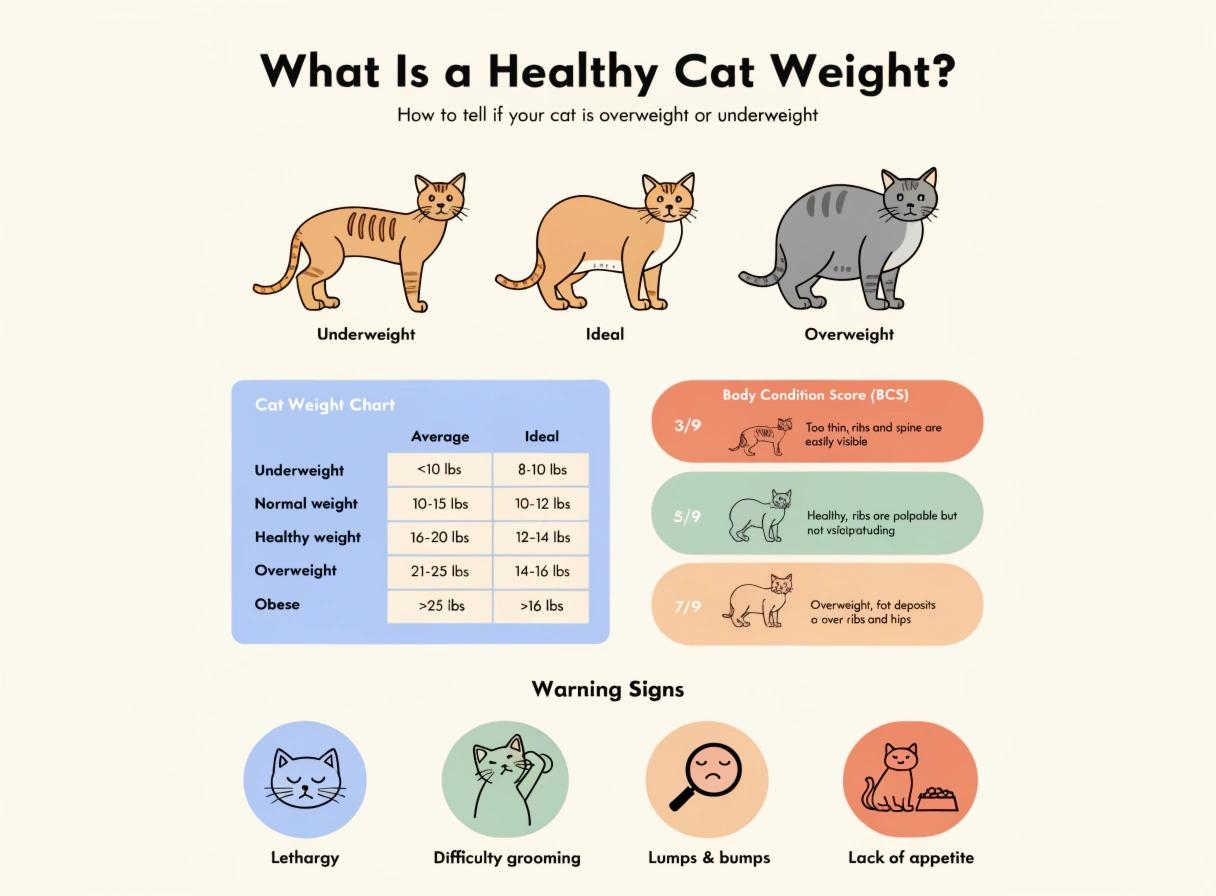
What Is a Healthy Cat Many adult domestic cats fall somewhere around 8–12 pounds, but healthy cat weight is not a universal number. Frame, breed, age, muscle, body fat and activity all matter, so treat the range as a starting point rather than a verdict. The scale matters. Body shape and weight history matter more. A large, muscular cat can be healthy above 12 pounds; a small-framed cat can carry excess fat at 10. Feel the ribs, look for a waist, and watch for drift from your cat's own baseline. ● Typical range 8–12 lb (3.6–5.4 kg) for most adult cats, around 10 lb being common — but healthy cats fall outside it. ● Healthy body condition Ribs easy to feel under a light fat cover, a visible waist from above, a slight tummy tuck from the side. ● Watch a change Any unplanned gain or loss, a fading waist, or sharper ribs, spine, or hips — book a vet check. ● Act quickly Fast weight loss, stopping eating, weakness, or loss paired with big appetite, thirst, or urination. Healthy Cat Weight: Start With Body Condition, Not Pounds Start with body condition rather than the scale. A cat near 10 pounds may be underweight, ideal or overweight depending on frame, muscle and fat coverage. Check the ribs, waist and abdominal profile, then compare the result with the cat's own weight trend. Weight check What to look for Healthy body condition Ribs are easy to feel under a light fat covering. A waist is visible from above, with a slight tummy tuck from the side. Possible underweight Ribs, spine, or hips look or feel sharp. The waist is very narrow, and muscle may be reduced. Possible overweight Ribs are difficult to feel, the waist fades, and the abdomen looks rounder. Veterinary advice Arrange a check if weight changes without a planned diet, or comes with changes in appetite, thirst, urination, stool, energy, or behavior. An average describes a population; an ideal weight belongs to one cat. Two cats at different weights can both have a healthy body condition, while two cats at the same weight may carry very different amounts of muscle and body fat. Cat Weight by Age and Breed: Reference Ranges Only Age and breed tables are broad reference points, not targets or diagnostic tools. Kittens are growing, healthy adults tend to remain relatively stable, and senior cats can lose muscle even when total weight changes very little. Life stage Age What to watch Kitten Birth to 6 months Rapid growth; weigh more often and watch for steady gain. Adolescent 7–12 months Growth slows as the cat approaches adult size. Adult 1–10 years Weight should remain fairly stable once growth is complete. Senior 11+ years Watch for muscle loss, reduced appetite, or an unexplained drop. 1. Kitten Weight Reference Kitten growth is not perfectly linear. Breed, sex, birth weight, nutrition and health all shift the numbers below, so use them only as broad reference ranges. A kitten that stops gaining, loses weight or becomes weak needs veterinary advice rather than a larger serving based on a chart. Age Common reference range 2 months About 1.5–2 lb 3 months About 3–4 lb 4 months About 4–5 lb 6 months About 6–7 lb 10–12 months About 8–10 lb 2. Adult Breed Weight Reference Breed estimates vary between sources and between males and females, and mixed-breed cats may not fit a chart neatly. Treat every number below as a broad reference only; body condition, muscle condition and the cat's own trend should guide the veterinary assessment. Breed Broad reference range Practical note Domestic Shorthair 8–12 lb Highly variable; use body condition more than a strict target. Siamese 6–10 lb Fine-boned and lean; small gains change body condition quickly. Persian 7–12 lb Dense coat can hide fat gain or muscle loss. Bengal 8–15 lb Often muscular and athletic. Ragdoll 10–20 lb Large frame and slower maturation. British Shorthair 9–17 lb Broad build; check that roundness is muscle, not fat. Sphynx 6–12 lb Medium-sized and muscular despite a light frame. Maine Coon 11–25 lb Large, long-bodied breed that may mature over several years. Check Your Cat’s Body Condition and Not Just Pounds Veterinary Body Condition Score guidance uses a 1–9 scale to estimate fat coverage, with 4–5/9 generally considered ideal. Muscle Condition Score is a separate assessment because a cat can lose muscle while still carrying excess fat. BCS Condition What you may see and feel 1–3 Underweight Ribs, spine, and hips are prominent; little fat is present. 4–5 Ideal Ribs are easy to feel, the waist is visible, and the abdomen tucks upward. 6–7 Overweight Ribs are harder to feel, the waist is less clear, and fat deposits increase. 8–9 Obese Ribs are difficult or impossible to feel, with a broad back and rounded abdomen. Feel the ribs Run both hands along the sides of the chest. You should feel each rib without pressing hard, but the bones should not feel sharp. Look from above and from the side From above, look for a gentle inward curve behind the ribs. From the side, the belly should rise slightly toward the back legs. Do not let fur fool you Long coats can hide both fat gain and muscle loss. Use your hands to assess the ribs, spine, shoulders, and hips instead of relying on the silhouette alone. Know the primordial pouch That loose flap in front of the hind legs is normal anatomy, not fat. It feels soft and swings when the cat walks. Excess abdominal fat feels thicker and usually comes with a poorly defined waist. What Affects a Cat’s Ideal Weight? Two adult cats can be equally healthy at very different weights. The factors below explain why. Factor Why it matters Breed and frame Height, body length, bone size, and chest width change how much healthy tissue a cat carries. Age Kittens are growing. Adults often get less active. Seniors may lose muscle or develop illness that shifts weight. Sex Males are often larger, but sex alone does not set a target weight. Spaying or neutering Appetite and energy needs change after surgery; research links increased food intake with post-neuter gain. Muscle and activity Muscle adds weight without making a cat overweight. Active cats need more energy than sedentary ones of the same size. Indoor lifestyle Indoor living is not the problem. Low activity, boredom, and easy food access are the real risks. Diet and health history Calorie density, treats, pain, dental disease, kidney disease, diabetes, and thyroid disease all affect weight or appetite. Multi-cat homes add a layer the charts ignore. One cat steals food, grazes from several bowls, or needs a different portion from its housemate. Feed separately when you can't tell who ate what. Don't use one cat as the household benchmark. Even littermates differ in frame and muscle. A petite 7-pound cat and a broad 13-pound cat can both be in good condition, while equal portions push one above and the other below its healthy range. How to Weigh and Monitor Your Cat at Home Home tracking works when the method stays consistent. One unusual reading tells you little; a clear pattern over weeks or months tells you much more. A monthly weigh-in is a simple way to spot a meaningful change early. Use a pet or baby scale Put the scale on a firm floor and add a thin nonslip towel. Zero it after the towel, then record the reading once your cat settles. Use a bathroom scale Weigh yourself, then weigh yourself holding your cat, and subtract. Less precise for small changes, but useful when you repeat it the same way every time. Keep the conditions similar Same scale, same time of day, same floor, same unit. Before breakfast on the same day each month is an easy routine to actually keep. Record more than weight Note Body Condition Score, rib feel, waist shape, appetite, activity, and one photo from the top and one from the side. Veterinary nutrition guidance recommends assessing body fat and muscle, not just the number. Cat Suggested home check Young kitten As directed by the veterinary team; very young kittens may need daily or frequent checks. Healthy adult About once a month is usually enough to spot a trend. Senior cat Monthly checks are useful because gradual loss is easy to miss. Weight plan or illness Follow the schedule set by the veterinary team. Why Weight Trends Matter Your cat's own baseline is more useful than another cat's number. One pound also represents a much larger change in a small cat: a drop from 8 to 7 pounds is 12.5%, while one pound is 5% of a 20-pound cat. Use this when a change looks small: weight change ÷ starting weight × 100. Say your cat drops from 10 to 9 pounds, that 1-pound loss is 10% of its body weight (1 ÷ 10 × 100), the same as a 150-pound person losing 15 pounds. It doesn't diagnose anything. It just tells you how big the shift really is for that cat. Weight is one signal among several. Appetite, thirst, energy, vomiting, stool and urination changes add important context, but neither a scale nor a litter box can diagnose why weight changed. Record the pattern and share it with your veterinarian. Slow changes Long fur and daily familiarity make gradual gain or loss almost invisible. Monthly weights and matching photos catch what memory misses. Sudden gain Check portions, food stealing, treats, and outside feeding first. Arrange a vet visit when gain is rapid, unexplained, or paired with a swollen abdomen, breathing changes, or reduced movement. Weight loss despite eating Guidance on feline hyperthyroidism lists weight loss with increased appetite among the most common signs. Guidance on feline diabetes notes weight loss despite a good appetite too, often with more thirst and urination. Both need testing. Stable weight with muscle loss An older cat can lose muscle around the shoulders, spine, and hips while gaining enough fat to hold the scale steady. Check muscle shape, not just total weight. Why Cats Gain or Lose Weight Most gain comes from taking in more calories than the body uses. Loss happens when a cat eats less, absorbs nutrients poorly, or burns energy unusually fast. Pattern Common possibilities Overweight cat Oversized portions, free feeding, treats, food stealing, meals from neighbors, less play, pain that reduces movement, or unchanged portions after neutering. Underweight cat Dental pain, reduced appetite, parasites, digestive disease, kidney disease, hyperthyroidism, diabetes, cancer, or another illness. Loss with a strong appetite Hyperthyroidism and diabetes are two possibilities and need testing. Change with normal portions Check activity, calorie density, other food sources, medication, and medical causes rather than assuming the label amount is right. A kitchen scale exposes portion creep fast. Weigh the full daily amount, then divide it across meals. Count treats and any food used for medication. In a house with several people, one shared feeding note stops the same cat collecting four “small” extras. Unplanned weight loss in a senior cat should not be dismissed as normal aging. Dental pain, kidney disease, hyperthyroidism, diabetes and other conditions can contribute, so arrange a veterinary assessment. Why a Healthy Weight Matters This is a matter of health, not appearance. Weight affects how easily a cat moves, grooms, climbs, and uses the litter box. Too much fat makes those daily jobs harder; too little leaves no muscle or reserve. Weight concern Possible effect Excess weight Harder jumping and grooming, less activity, more stress on joints, higher risk of some chronic diseases. Low weight Reduced muscle, weakness, poor coat condition, and less reserve during illness. Either direction A sudden or unexplained change may be the first visible sign something else has changed. Excess weight is associated with conditions including diabetes and joint disease. Low weight may reflect inadequate intake, muscle loss or an underlying illness that needs assessment. Small changes deserve attention because cats are small. One pound is 10% of a 10-pound cat. That's not automatically disease, but it's big enough to record and follow when the trend holds. How to Reach and Maintain a Healthy Weight Start with a veterinary assessment when your cat is clearly underweight, overweight, or changing without explanation. A safe plan protects muscle and doesn't push the body too fast. 1. For an Overweight Cat Measure meals, stop uncounted bowl refills, feed cats separately and add short play sessions suited to your cat's mobility. Puzzle feeders may help with pacing. AAHA advises that cats should lose no more than about 1–2% of body weight per week under a veterinary plan. ⚠ DO NOT CRASH DIET Never crash diet a cat or allow prolonged fasting. Merck Veterinary Manual guidance explains that food deprivation can set the stage for hepatic lipidosis — fatty liver disease — especially in overweight cats. Rapid loss is the danger, not slow progress. 2. For an Underweight Cat Find the cause before piling on food. Dental pain, nausea, chronic disease, and competition at the bowl all cut intake. Once illness is addressed, smaller frequent meals, a quiet feeding spot, and a suitable calorie-dense diet may help — under veterinary guidance. Keep meals measured and predictable. Recheck portions after neutering, injury, a move indoors, or a big drop in activity. Weigh monthly, reassess Body Condition Score, and bring the record to routine visits. When to Contact a Veterinarian Weight is rarely the only clue. The speed of the change and the signs around it tell you how fast to move. Level When to act Arrange an appointment Unplanned gain or loss; ribs, spine, or hips becoming more visible; the waist disappearing; a senior cat losing weight; changes in appetite, thirst, urination, stool, energy, or behavior. Seek prompt or urgent care Your cat stops eating, loses weight quickly, can't keep food or water down, has ongoing vomiting or diarrhea, becomes weak or unsteady, or has trouble breathing. Health and safety note: This article is for general educational purposes only and is not a substitute for veterinary diagnosis or treatment. Contact a veterinarian if you are concerned about a change in your cat's health or litter box habits. FAQs Is 12 lb a good weight for a cat? Twelve pounds can be healthy for some cats, but the number alone cannot answer the question. Check whether the ribs are easy to feel, the waist is visible from above and the abdomen has a slight upward tuck. Is a 15 lb cat overweight? A 15-pound cat may be overweight, especially if the cat has a small or medium frame. Large or muscular cats can be healthy at that weight, so body condition and weight history matter more than the number alone. Is 20 lbs heavy for a cat? Yes, 20 pounds is heavy for most domestic cats. Some large breeds may fall near that range, but the cat should still have easy-to-feel ribs, a visible waist, and no heavy fat covering. What is a healthy weight for an indoor cat? Many healthy indoor cats weigh about 8–12 pounds. The ideal weight depends on frame, muscle, age, activity level, and whether the cat maintains a healthy Body Condition Score. Is 7 pounds a healthy weight for a cat? Yes, 7 pounds can be healthy for a petite or small-framed adult cat. It may be too low if the ribs, spine, or hips are very visible or if the cat has lost weight without explanation. How skinny is too skinny for a cat? A cat may be too thin when the ribs, spine, or hip bones are clearly visible or feel sharp with little fat or muscle covering them. A sudden drop in weight, weakness, or appetite changes should be checked by a veterinarian. How fast should a cat lose weight? Slowly. AAHA advises no more than about 1–2% of body weight per week, and some cats need a slower target. Any weight-loss plan should be supervised by a veterinarian because inadequate intake can contribute to hepatic lipidosis. Sources AAHA — Feline Fitness: How to Help Your Cat Lose Weight AAHA — Feline Body Condition Score Cornell Feline Health Center — Feeding Your Cat Cornell Feline Health Center — Hyperthyroidism in Cats Cornell Feline Health Center — Feline Diabetes Cornell Feline Health Center — Obesity Merck Veterinary Manual — Feline Hepatic Lipidosis
|
● Typical range
|
8–12 lb (3.6–5.4 kg) for most adult cats, around 10 lb being common — but healthy cats fall outside it.
|
|
● Healthy body condition
|
Ribs easy to feel under a light fat cover, a visible waist from above, a slight tummy tuck from the side.
|
|
● Watch a change
|
Any unplanned gain or loss, a fading waist, or sharper ribs, spine, or hips — book a vet check.
|
|
● Act quickly
|
Fast weight loss, stopping eating, weakness, or loss paired with big appetite, thirst, or urination.
|
Healthy Cat Weight: Start With Body Condition, Not Pounds
|
Weight check
|
What to look for
|
|
Healthy body condition
|
Ribs are easy to feel under a light fat covering. A waist is visible from above, with a slight tummy tuck from the side.
|
|
Possible underweight
|
Ribs, spine, or hips look or feel sharp. The waist is very narrow, and muscle may be reduced.
|
|
Possible overweight
|
Ribs are difficult to feel, the waist fades, and the abdomen looks rounder.
|
|
Veterinary advice
|
Arrange a check if weight changes without a planned diet, or comes with changes in appetite, thirst, urination, stool, energy, or behavior.
|
Cat Weight by Age and Breed: Reference Ranges Only

|
Life stage
|
Age
|
What to watch
|
|
Kitten
|
Birth to 6 months
|
Rapid growth; weigh more often and watch for steady gain.
|
|
Adolescent
|
7–12 months
|
Growth slows as the cat approaches adult size.
|
|
Adult
|
1–10 years
|
Weight should remain fairly stable once growth is complete.
|
|
Senior
|
Watch for muscle loss, reduced appetite, or an unexplained drop.
|
1. Kitten Weight Reference
|
Age
|
Common reference range
|
|
2 months
|
About 1.5–2 lb
|
|
3 months
|
About 3–4 lb
|
|
4 months
|
About 4–5 lb
|
|
6 months
|
About 6–7 lb
|
|
10–12 months
|
About 8–10 lb
|
2. Adult Breed Weight Reference
|
Breed
|
Broad reference range
|
Practical note
|
|
Domestic Shorthair
|
8–12 lb
|
Highly variable; use body condition more than a strict target.
|
|
Siamese
|
6–10 lb
|
Fine-boned and lean; small gains change body condition quickly.
|
|
Persian
|
7–12 lb
|
Dense coat can hide fat gain or muscle loss.
|
|
Bengal
|
8–15 lb
|
Often muscular and athletic.
|
|
Ragdoll
|
10–20 lb
|
Large frame and slower maturation.
|
|
British Shorthair
|
9–17 lb
|
Broad build; check that roundness is muscle, not fat.
|
|
Sphynx
|
6–12 lb
|
Medium-sized and muscular despite a light frame.
|
|
Maine Coon
|
11–25 lb
|
Large, long-bodied breed that may mature over several years.
|
Check Your Cat’s Body Condition and Not Just Pounds

|
BCS
|
Condition
|
What you may see and feel
|
|
1–3
|
Underweight
|
Ribs, spine, and hips are prominent; little fat is present.
|
|
4–5
|
Ideal
|
Ribs are easy to feel, the waist is visible, and the abdomen tucks upward.
|
|
6–7
|
Overweight
|
Ribs are harder to feel, the waist is less clear, and fat deposits increase.
|
|
8–9
|
Obese
|
Ribs are difficult or impossible to feel, with a broad back and rounded abdomen.
|
-
Feel the ribs
-
Look from above and from the side
-
Do not let fur fool you
-
Know the primordial pouch
What Affects a Cat’s Ideal Weight?
|
Factor
|
Why it matters
|
|
Breed and frame
|
Height, body length, bone size, and chest width change how much healthy tissue a cat carries.
|
|
Age
|
Kittens are growing. Adults often get less active. Seniors may lose muscle or develop illness that shifts weight.
|
|
Sex
|
Males are often larger, but sex alone does not set a target weight.
|
|
Spaying or neutering
|
Appetite and energy needs change after surgery; research links increased food intake with post-neuter gain.
|
|
Muscle and activity
|
Muscle adds weight without making a cat overweight. Active cats need more energy than sedentary ones of the same size.
|
|
Indoor lifestyle
|
Indoor living is not the problem. Low activity, boredom, and easy food access are the real risks.
|
|
Diet and health history
|
Calorie density, treats, pain, dental disease, kidney disease, diabetes, and thyroid disease all affect weight or appetite.
|
How to Weigh and Monitor Your Cat at Home

-
Use a pet or baby scale
-
Use a bathroom scale
-
Keep the conditions similar
-
Record more than weight
|
Cat
|
Suggested home check
|
|
Young kitten
|
As directed by the veterinary team; very young kittens may need daily or frequent checks.
|
|
Healthy adult
|
About once a month is usually enough to spot a trend.
|
|
Senior cat
|
Monthly checks are useful because gradual loss is easy to miss.
|
|
Weight plan or illness
|
Follow the schedule set by the veterinary team.
|
Why Weight Trends Matter
-
Slow changes
-
Sudden gain
-
Weight loss despite eating
-
Stable weight with muscle loss
Why Cats Gain or Lose Weight

|
Pattern
|
Common possibilities
|
|
Overweight cat
|
Oversized portions, free feeding, treats, food stealing, meals from neighbors, less play, pain that reduces movement, or unchanged portions after neutering.
|
|
Underweight cat
|
Dental pain, reduced appetite, parasites, digestive disease, kidney disease, hyperthyroidism, diabetes, cancer, or another illness.
|
|
Loss with a strong appetite
|
Hyperthyroidism and diabetes are two possibilities and need testing.
|
|
Change with normal portions
|
Check activity, calorie density, other food sources, medication, and medical causes rather than assuming the label amount is right.
|
Why a Healthy Weight Matters

|
Weight concern
|
Possible effect
|
|
Excess weight
|
Harder jumping and grooming, less activity, more stress on joints, higher risk of some chronic diseases.
|
|
Low weight
|
Reduced muscle, weakness, poor coat condition, and less reserve during illness.
|
|
Either direction
|
A sudden or unexplained change may be the first visible sign something else has changed.
|
How to Reach and Maintain a Healthy Weight
1. For an Overweight Cat
|
⚠ DO NOT CRASH DIET
Never crash diet a cat or allow prolonged fasting. Merck Veterinary Manual guidance explains that food deprivation can set the stage for hepatic lipidosis — fatty liver disease — especially in overweight cats. Rapid loss is the danger, not slow progress.
|
2. For an Underweight Cat
When to Contact a Veterinarian
|
Level
|
When to act
|
|
Arrange an appointment
|
Unplanned gain or loss; ribs, spine, or hips becoming more visible; the waist disappearing; a senior cat losing weight; changes in appetite, thirst, urination, stool, energy, or behavior.
|
|
Seek prompt or urgent care
|
Your cat stops eating, loses weight quickly, can't keep food or water down, has ongoing vomiting or diarrhea, becomes weak or unsteady, or has trouble breathing.
|
|
Health and safety note: This article is for general educational purposes only and is not a substitute for veterinary diagnosis or treatment. Contact a veterinarian if you are concerned about a change in your cat's health or litter box habits.
|
FAQs
Is 12 lb a good weight for a cat?
Is a 15 lb cat overweight?
Is 20 lbs heavy for a cat?
What is a healthy weight for an indoor cat?
Is 7 pounds a healthy weight for a cat?
How skinny is too skinny for a cat?
How fast should a cat lose weight?
Sources
- AAHA — Feline Fitness: How to Help Your Cat Lose Weight
- AAHA — Feline Body Condition Score
- Cornell Feline Health Center — Feeding Your Cat
- Cornell Feline Health Center — Hyperthyroidism in Cats
- Cornell Feline Health Center — Feline Diabetes
- Cornell Feline Health Center — Obesity
- Merck Veterinary Manual — Feline Hepatic Lipidosis
You may also like

AutoScooper 11 Cat Litter Box


AutoScooper 11 Litter Base Bed – 2 Pack

AutoScooper 11 Waste Bags – 60 Count


AutoScooper 12 Lite Cat Litter Box
Further reading

Why Does Cat Poop Smell So Bad? 8 Real Causes and Quick Fixes
How Long Can a Cat Go Without Pooping: Signs & Help
What Is a Healthy Cat Weight? Chart, Body Condition and Warning Signs
