
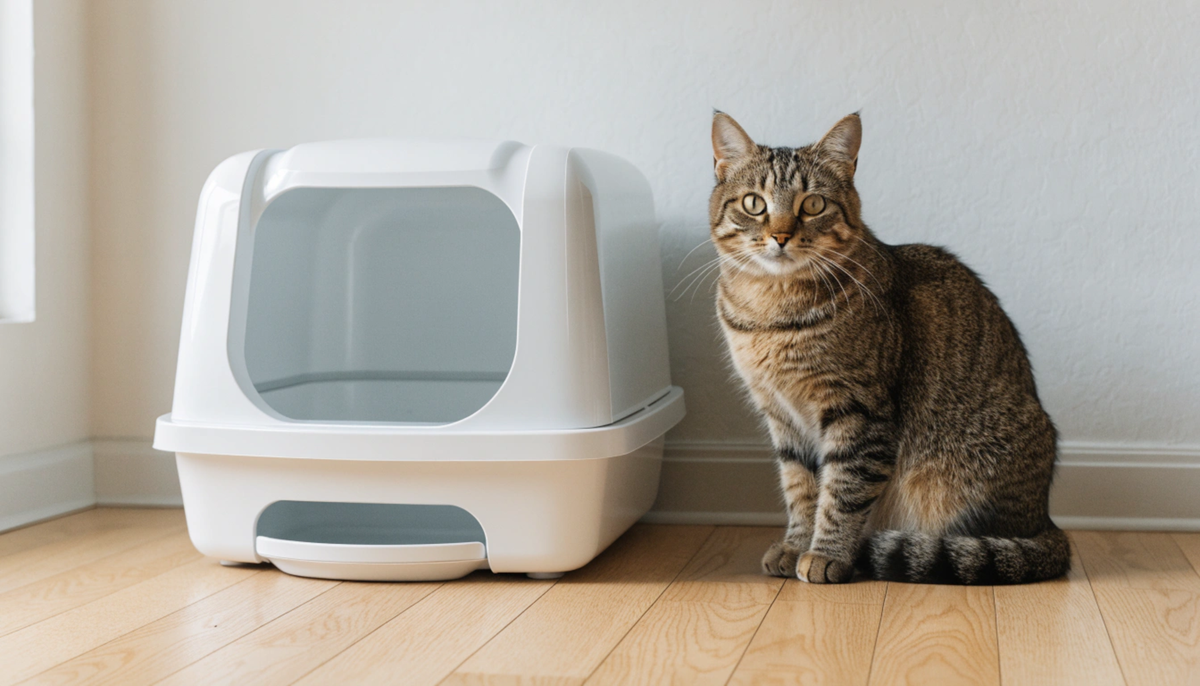
Automatic Litter Box Safety Checklist: 12 Checks Before You Switch It On

About the Author
An automatic litter box is safe when it detects your cat before the drum moves, waits after the cat leaves, stops the moment the cat comes back, and keeps the exit open the whole time. Miss any one of those four and the machine is a risk, no matter how many sensors the box claims. Below is a 12-point automatic litter box safety checklist you can run before you buy, plus a supervised test to do on day one. It also covers red flags, kittens, secondhand units and what to do if the machine jams. For the wider question of whether automatic litter boxes are safe at all, start there instead. Quick answer: are automatic litter boxes safe? For most healthy adult cats, yes, if the design is right and you set it up properly. Safety is not a property of the category. It depends on the specific model, your cat, and your setup. Kittens, frail seniors, very large cats, and noise-sensitive cats need more caution. Some are better off with a plain tray, and that is a reasonable outcome, not a failure. Sensors alone guarantee nothing. What matters is what the machine does the instant a sensor fires. The 12-point automatic litter box safety checklist Run this before you pay. Anything you cannot answer from the manual or the product page counts as a fail, not a maybe. A brand that will not describe its own safety system in plain language is telling you something. # Check Pass looks like 1 The entrance stays open through the whole cycle You can see a clear exit at every stage of rotation 2 At least two independent detection methods Weight plus infrared, or visual plus weight 3 A delay between the cat leaving and cleaning starting A stated number of minutes, not just 'automatic' 4 Documented stop on re-entry behavior The manual says it pauses, reverses, or resets 5 A mechanical limit that works without electronics A physical stop or rotation limiter, described 6 Published minimum cat weight A number, commonly 2.2 to 3.3 lbs depending on model 7 Published interior dimensions, not just the shell Litter bed size and entry height listed separately 8 Automatic mode can be switched off A manual or kitten mode you control 9 Named litter type and particle size Clumping mineral, tofu, or a stated maximum length 10 A downloadable manual and named manufacturer PDF manual, model number, contact address 11 Warranty terms and replacement parts sold Length stated, parts listed in the store 12 No recall or safety notice on the model Nothing found in the CPSC recall database Where the risk actually comes from Every automatic box carries the same basic hazard: something moves in a space your cat sits in. The design decides how much room for error there is. Side rotating globes A globe tilts and spins so gravity pushes waste through a screen into a drawer. As it turns, the opening moves with it. In some designs, the entrance narrows or closes partway through. That is the design worth studying hardest. A closing exit is the one failure mode that traps rather than pinches. Front-to-back and open-top sifters These tip backward instead of rolling sideways. Open top versions keep the top of the chamber clear throughout, which removes the trapping problem entirely, though pinch points can still form at the rim. Our comparison of open and enclosed designs covers what each format gives up. Rake style trays A motorized comb crosses a flat litter bed on exposed tracks. No enclosure means nothing can shut on the cat, but the rake applies force across the whole tray, and a hardened clump can stall it mid-sweep. Cheaper to buy. More things to catch a tail on. Which sensors matter, and what each one misses Every sensor type has a blind spot. Knowing the blind spot is more useful than counting the sensors. Weight sensors under the base They read the load change as a cat steps in or out, and they hold the drum still while weight is present. They fail on thick carpet, which absorbs the load, and they fail on cats too light to register. They also drift after you add litter until you re-level the unit. Infrared beams at the entrance A broken beam means something is there. Infrared catches an approaching cat that hasn't yet put weight on the step, which is exactly when weight sensors miss. Dust on the lens quietly degrades it. That is why sensor wiping is a safety task, not a cleaning task. Anti-pinch and motor resistance Resistance detection watches the motor load and stops when something unexpected pushes back. It is a last line, not a first line, because by definition it triggers after contact. Look for wording on what actually stops the drum. A label on its own means little. Why layering beats counting Twelve sensors on one principle is weaker than three on different principles. PetPivot's four-layer safety architecture is a useful example of the structure to look for: infrared presence detection, active anti-pinch, a mechanical rotation limiter that works whether the electronics do or not, and Hall sensors tracking drum position in real time. The mechanical layer matters most. Electronics fail. A physical stop does not care. The safety test most owners skip Nobody writes this part down, so most people switch on automatic mode and hope. Do this instead, on day one, with your cat shut in another room. You are testing the machine, not the cat. The cat is never part of the test. Assemble it exactly as the manual says, on hard-level flooring, with the required gap from the wall. Fill litter to the marked line, then run the leveling or reset function so the sensors calibrate correctly. Start a manual cycle and watch the entrance through the full rotation. Note whether the opening ever narrows. Use the manufacturer's approved interruption method to trigger a stop mid-cycle. Never put your hand into a moving mechanism. Confirm the unit stops, reports the interruption, and does not silently resume. Repeat twice. A safety response that works once and not the second time is a fault, not a fluke. The AutoScooper setup and manual pages list the exact leveling step and the interruption method for those units. Every brand words this differently, so use the document for your model. If the behavior is inconsistent across three runs, stop. Contact support before the cat goes near it. Red flags that should stop the purchase These are the warning signs worth walking away from, in rough order of seriousness. Red flag Why it matters The entrance closes or narrows mid-cycle This is the trapping risk. A startled cat cannot leave, and panic makes it worse. No identifiable manufacturer or model number You cannot check recalls, get a manual, or claim a warranty on a machine nobody owns. Sensors described only as 'smart safety sensors' A maker that will not say what its sensors detect has not thought hard about it. No published minimum weight. You cannot know whether your cat registers at all, which is the whole basis of detection. No documented re-entry response Curious cats walk back in. Silence on this point means no confidence. Automatic mode cannot be turned off. No manual mode means no control during introduction, troubleshooting, or a kitten's first months. The unit restarts on its own after a jam. A jam needs a human to look at it. Auto restart turns one fault into a repeated one. The same shell appears under several unknown brands Rebadged units share the same engineering and the same faults, without a support chain. Kittens, seniors and large cats The checklist changes depending on who is using the box. Kittens may not register at all. A kitten below the sensor threshold is invisible to a weight plate. Check the exact figure for your model rather than a general rule, since minimums range from about 2.2 lbs to 3.3 lbs across brands. Below the threshold, run manual mode only and keep a low-sided tray alongside. Turn automatic mode on once the kitten passes the published weight, then supervise the first week. Seniors need access, not just sensors. Arthritis makes a tall threshold painful. Many units sit high to fit a drawer underneath, which forces an awkward lift for a stiff cat. Watch for hesitation at the entrance, a paused half step, or a cat that starts going next to the box instead of in it. That is a fit problem, not a behavior problem. Large cats need interior space. A 22 lb weight rating tells you nothing about room to turn. VCA notes that most cats prefer a box at least one and a half times their body length, which you can measure at home with a tape measure and a cooperative cat. Measure the litter bed, not the shell. For a Maine Coon or a long-bodied Ragdoll, the larger AutoScooper 11 with a 15.35-inch square entryway is closer to the right size than most compact units. Secondhand and unbranded units This comes up constantly in owner forums and rarely in buying guides. Someone is given a machine with no box, no manual, and no model label. You cannot evaluate what you cannot identify. No model number means no recall check, no manual, no parts, and no support. Find the label on the base first. If there is one, look the model up in the CPSC recall listings and download the manual before plugging anything in. Inspect the cord, the sensor windows, and the drum edges for damage. If you cannot identify it, do not power it. An unplugged machine still makes a perfectly good cat bed, which is what many owners end up doing. If the box jams or stops mid-cycle A stall is the machine telling you something. Handle it in this order. Move the cat out of the room before anything else. Switch off and unplug at the wall. Do not work on a powered unit. Follow the manual's jam-clearing steps, and remove only the parts it names as user-serviceable. Look for hardened clumps under the drum, litter in the track, or a panel that has shifted out of alignment. Never force the drum or rake by hand to free it. That is how gears strip and how fingers get caught. If the same fault returns, stop using it and contact support. Keep the backup tray in service until it is fixed. Keeping the safety systems working Maintenance is what keeps detection accurate. A neglected box is a less safe box, and the decline is gradual enough that you will not notice. Wipe the sensor windows every time you empty the drawer. Keep litter between the marked minimum and maximum, since too little lets liquid reach the tray floor and cement itself there. The cleaning and upkeep schedule sets out which parts come apart and how long they need to dry. Use only the litter type the maker names. Most sifting machines want clumping mineral or bentonite in a fine grain, which is why PoPoLitter fine grain mineral litter is built to that spec. Crystal and long strip tofu litters jam mechanisms and throw off weight readings. Install firmware updates if your model has them. Never bypass a sensor or clear an error just to force a cycle. That stop is the system doing its job. Do not let automation hide a health problem. Fast cleaning removes the evidence you used to see while scooping. Cornell notes that changes in litter box habits are often the first sign of a medical issue, so check the drawer before you empty it, not after. Usage and weight logs help, but they flag change without explaining it. Our guide on what a litter box can and cannot tell you about waste covers those limits honestly. Straining with little or no urine, crying in the box, or repeated unproductive visits is an emergency, especially in male cats. Call a vet the same day. Final verdict Buy the model whose maker will tell you, in writing, what its sensors detect and what the machine does when they fire. Then test that behavior yourself before your cat ever sees automatic mode. Suppose you want the shortest version: open entry, two detection methods, a mechanical limiter, a published minimum weight, and a manual mode. The 12 Lite with its four-layer stack meets that list, and so do several machines from other brands. Keep a plain tray as backup regardless, and use the trial window. PetPivot's 30-day return terms exist because no spec sheet predicts whether your cat will accept a machine. If it does not work out, a low open box is a perfectly good answer. For the introduction itself, work through a paced adaptation routine rather than switching everything on at once. FAQS Are automatic litter boxes safe? For most healthy adult cats, yes, when the design keeps the exit open, detects the cat with more than one sensor type, delays cleaning after the cat leaves, and stops on re-entry. Safety depends on the specific model and setup, not the category. Kittens, frail seniors, and anxious cats need more caution. Do vets recommend automatic litter boxes? Many are comfortable with them for healthy adult cats, provided the design is sound, and the owner still monitors the cat. Vets are more cautious about kittens, frail seniors and cats with known urinary problems, mainly because automatic cleaning removes the waste they want you watching. Ask your own vet about your cat. What is the golden rule for litter boxes? One box per cat, plus one extra, placed in separate quiet locations. An automatic box counts as one box, so a three-cat home still needs four. The rule exists so no cat is ever blocked from a clean box by another cat, which is a common trigger for house soiling. What kind of litter should be used in an automatic litter box? Whatever the manufacturer names, and no more than that. Most sifting machines need clumping mineral or bentonite litter in a fine grain. Some accept tofu or mixed litter with a second sifter fitted. Crystal and long-strip litters usually don't sift correctly and can jam the mechanism outright. Are cats scared of automatic litter boxes? Some are, and that is a fit issue rather than a fault. Noise, movement, and enclosed shapes can put certain cats off, even when the machine works perfectly. A slow introduction with the unit switched off usually fixes it. If your cat still refuses after several weeks, go back to a plain tray. How do I know if my cat is too light for the sensors? Check the published minimum weight for your exact model and weigh your cat, since thresholds vary from roughly 2.2 lbs to 3.3 lbs between brands. If your cat is under that weight, don't assume the box detects them. Run manual mode only, and keep a conventional tray available until they grow into it. Have automatic litter boxes injured cats? Owners report injuries across the category, most often involving units where the entrance closed during the cycle or detection failed. We do not repeat brand-specific injury claims we cannot verify. Check the CPSC recall database for your exact model, since that record carries legal weight. Is it bad to sleep near a cat litter box? It is mainly a comfort and hygiene question rather than a documented health risk for healthy adults. A sealed drawer and regular emptying keep odor down in a bedroom. Cats often prefer quiet, low-traffic rooms anyway, so if the box lives in your bedroom, empty it on schedule and keep the sensors clean. Sources Cornell Feline Health Center, Feline Behavior Problems: House Soiling (2026) VCA Animal Hospitals, Cat Behavior Problems: House Soiling in Cats (2024) Feline Veterinary Medical Association, 2014 AAFP/ISFM Guidelines for Diagnosing and Solving House-soiling Behavior in Cats (2014) The Ohio State University Indoor Pet Initiative, Litter Boxes (2026) PubMed, Litter Box Preference in Domestic Cats: Covered Versus Uncovered (2013) International Cat Care, Stress in Cats (2025) U.S. Consumer Product Safety Commission, Recalls and Product Safety Warnings (2026)
Quick answer: are automatic litter boxes safe?

The 12-point automatic litter box safety checklist

|
#
|
Check
|
Pass looks like
|
|
1
|
The entrance stays open through the whole cycle
|
You can see a clear exit at every stage of rotation
|
|
2
|
At least two independent detection methods
|
Weight plus infrared, or visual plus weight
|
|
3
|
A delay between the cat leaving and cleaning starting
|
A stated number of minutes, not just 'automatic'
|
|
4
|
Documented stop on re-entry behavior
|
The manual says it pauses, reverses, or resets
|
|
5
|
A mechanical limit that works without electronics
|
A physical stop or rotation limiter, described
|
|
6
|
Published minimum cat weight
|
A number, commonly 2.2 to 3.3 lbs depending on model
|
|
7
|
Published interior dimensions, not just the shell
|
Litter bed size and entry height listed separately
|
|
8
|
Automatic mode can be switched off
|
A manual or kitten mode you control
|
|
9
|
Named litter type and particle size
|
Clumping mineral, tofu, or a stated maximum length
|
|
10
|
A downloadable manual and named manufacturer
|
PDF manual, model number, contact address
|
|
11
|
Warranty terms and replacement parts sold
|
Length stated, parts listed in the store
|
|
12
|
No recall or safety notice on the model
|
Nothing found in the CPSC recall database
|
Where the risk actually comes from

Side rotating globes
Front-to-back and open-top sifters

Rake style trays
Which sensors matter, and what each one misses

Weight sensors under the base
Infrared beams at the entrance
Anti-pinch and motor resistance
Why layering beats counting

The safety test most owners skip

-
Assemble it exactly as the manual says, on hard-level flooring, with the required gap from the wall.
-
Fill litter to the marked line, then run the leveling or reset function so the sensors calibrate correctly.
-
Start a manual cycle and watch the entrance through the full rotation. Note whether the opening ever narrows.
-
Use the manufacturer's approved interruption method to trigger a stop mid-cycle. Never put your hand into a moving mechanism.
-
Confirm the unit stops, reports the interruption, and does not silently resume.
-
Repeat twice. A safety response that works once and not the second time is a fault, not a fluke.
Red flags that should stop the purchase
|
Red flag
|
Why it matters
|
|
The entrance closes or narrows mid-cycle
|
This is the trapping risk. A startled cat cannot leave, and panic makes it worse.
|
|
No identifiable manufacturer or model number
|
You cannot check recalls, get a manual, or claim a warranty on a machine nobody owns.
|
|
Sensors described only as 'smart safety sensors'
|
A maker that will not say what its sensors detect has not thought hard about it.
|
|
No published minimum weight.
|
You cannot know whether your cat registers at all, which is the whole basis of detection.
|
|
No documented re-entry response
|
Curious cats walk back in. Silence on this point means no confidence.
|
|
Automatic mode cannot be turned off.
|
No manual mode means no control during introduction, troubleshooting, or a kitten's first months.
|
|
The unit restarts on its own after a jam.
|
A jam needs a human to look at it. Auto restart turns one fault into a repeated one.
|
|
The same shell appears under several unknown brands
|
Rebadged units share the same engineering and the same faults, without a support chain.
|
Kittens, seniors and large cats
Kittens may not register at all.
Seniors need access, not just sensors.
Large cats need interior space.

Secondhand and unbranded units

If the box jams or stops mid-cycle

-
Move the cat out of the room before anything else.
-
Switch off and unplug at the wall. Do not work on a powered unit.
-
Follow the manual's jam-clearing steps, and remove only the parts it names as user-serviceable.
-
Look for hardened clumps under the drum, litter in the track, or a panel that has shifted out of alignment.
-
Never force the drum or rake by hand to free it. That is how gears strip and how fingers get caught.
-
If the same fault returns, stop using it and contact support. Keep the backup tray in service until it is fixed.
Keeping the safety systems working

Do not let automation hide a health problem.

Final verdict

FAQS
Are automatic litter boxes safe?
Do vets recommend automatic litter boxes?
What is the golden rule for litter boxes?
What kind of litter should be used in an automatic litter box?
Are cats scared of automatic litter boxes?
How do I know if my cat is too light for the sensors?
Have automatic litter boxes injured cats?
Is it bad to sleep near a cat litter box?
Sources
You may also like


Further reading
Automatic Litter Box Safety Checklist: 12 Checks Before You Switch It On
Self-Cleaning Litter Box Pros and Cons: Honest Guide Before You Buy
Publication Draft Traditional Litter Boxes vs. Self-Cleaning Litter Boxes: Which Is Right for Your Cat?
